Written by
Esther Platt
ChurchWorks

Over the last three years, Accelerate Wellbeing has journeyed with five wellbeing projects. These projects are working in partnership with the health and care sector to deliver holistic wellbeing support to local communities. We have worked with them to scale or replicate their impact. One of these projects is the Whole Person Health Trust who facilitate chaplaincy in Primary Care in Bethnal Green. Ahead of the release of our Accelerate Wellbeing impact report and online event on 8 th December, Dr Louise Vaughan shares some insights into the impact of the chaplaincy programme.
“Until recently the health professions have largely followed a medical model, which seeks to treat patients by focussing on medicines and surgery, and gives less importance to beliefs and to faith. This reductionism or mechanistic view of the patient as being only a material body is no longer satisfactory. Patients and physicians have begun to realise the value of elements such as faith, hope and compassion in the healing process.”
(World Health Organisation (WHO), 1998)
Chaplaincy is about accompaniment, holding space, journeying and listening. In Primary Care (GP) chaplaincy, we define spirituality as that which brings meaning, purpose, hope and connectedness. In supporting spiritual health we aim to recognise and frame spiritual distress and unmet need. The chaplaincy service in Bethnal Green was started in 1997 at The Mission Practice. However since 2023, the rate of referrals to chaplains has more than tripled and the service is now available to over 30,000 patients registered at four GP practices in Bethnal Green and has a team of 6 part time chaplains, two of whom receive non recurrent NHS funding and the rest, voluntary, totalling 5.75 days per week. The service is available in the most common community language, Bengali, as well as French and English and chaplains offer a variety of special interests such as grief and loss; special educational needs support; homeless and addiction. The service works closely with the Association of Chaplaincy in General Practice, which provides training, accreditation and governance for UK primary care chaplaincy. It is the only primary care chaplaincy service in London.
We wanted to understand more about the impact of our chaplaincy and were encouraged by our key findings:
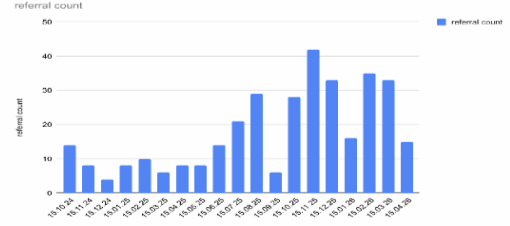
Spiritual need is significant, we’re probably missing a lot of it, but we don’t know how much! We already knew the result from a Danish study published in the Lancet in 2023 showed over 80% of a very secularised society had strong or very strong spiritual needs. It is widely reported that medical undergraduate training in spiritual health is minimal which can translate to unrecognised spiritual distress (most often framed as mental distress in the absence of a professional spiritual lens). Even in a GP practice with a strong culture of spiritual health, one session of training in September 2025 increased referrals. As of October 2026 350 patients have been referred to chaplaincy each year. This is 1% of the total population that the surgeries cover and the rate is increasing continually.
2. Primary Care Chaplaincy is for everyone, regardless of religious or spiritual identity.
Bethnal Green is a highly diverse area. Once we have understood the concept of spirituality being both necessary for health as part of a whole person framework that also includes physical, psychological and social wellbeing (also included in the GMC guidelines for Good Medical Practice); we can engage with the paradigm that every individual needs spiritual care. Our data show that the ethnicity of those referred almost exactly mirrors that of the local community.
Primary Care Chaplaincy meets felt needs and is broad in its impact
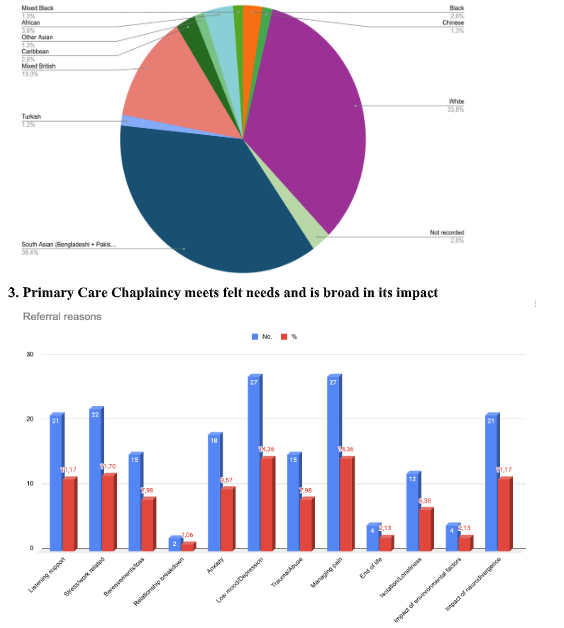
Interestingly, although listening, stress, loss, loneliness and anxiety are common and expected reasons for referrals; most common are depression, pain and the impact of neurodivergence. GPs will readily admit the complexities and frustrations of managing patients with chronic pain where pharmacological (drug) solutions are inadequate at best and long waits for hospital pain clinics rarely hugely impactful. Framing chronic pain as a spiritual issue (at least in part),may bring opportunities for exploring issues around disappointment, hopelessness, fear, loss, guilt and existential questions that are just not being met in even the most holistic multi disciplinary pain service. The same could be said of the impact of neurodivergence. With 2-3 year waits for a diagnosis in children and over 10 for some adults; it seems that neither health nor education has any answers for those who are clearly suffering and often feeling abandoned with no resource.
The NHS suicide prevention strategy 2025 lists “offering realistic hope” as part of an effective management plan. If chaplains are “hope bringers”, can they offer another unique service where usual care is creaking at the seams?
4. Primary Care Chaplaincy is highly trusted and recommended by those who receive it to others
Patient interviews high levels of trust in the chaplains they met with.
“I didn’t feel like I was being ‘diagnosed’, I could just talk.”
“It was a safe space where I could say things I wouldn’t say to a doctor.”
Most participants reported improvements in mood, coping and a sense of being heard.
“It helped me make sense of everything that was going on in my head. I feel lighter.”
Others mentioned that having someone to talk to regularly reduced their feelings of isolation. All interviewees said they would recommend the service to others.
Going forward
These preliminary findings show that there is significant potential spiritual need with which churches and spiritual communities can engage fruitfully. They also show that these need aren't just those "soft" issues but may be the stuff of everyday life that is open to accompanying presence. Here we can have a significant positive impact on patients who can be seen and held as they navigate challenges that cannot be neatly met by other services.
If you are interested in engaging in primary care chaplaincy, then please get in touch.
Come along on the 8th December to learn more from our Accelerate Wellbeing projects and explore how engaging in wellbeing in your community might look like. Book your place here.